In 2011, social psychologist Diederik Stapel was accused of faking his data. As allegations mounted, Stapel admitted to fraud and was fired his university post. The incident was widely covered in the news (I blogged about it here) and is one of the precipitating events for the current conversation in psychology about reproducibility.
Two years after the scandal broke, Stapel wrote an autobiography, "Ontsporing", or "Derailment". An English translation of this autobiography is now freely available for anyone to read.
If Stapel is an admitted liar, why should we take his autobiography seriously? The thing is, although less severe forms of scientific misconduct are more common, outright fraud is
rare -- about 1.97% of scientists admit to committing fraud in surveys on the subject (Fanelli, 2009). Rarer still is for someone admit to fraud publicly and then go on to write about their experiences. Stapel's autobiography therefore has value in that it provides a window into the psychology of someone who did not just tiptoe the shallows of scientific misconduct, but who dove in headfirst.
In other words, I thought I might learn something about why Stapel decided to commit fraud by reading about his experiences in his own words. So I did.
Showing posts with label reproducibility. Show all posts
Monday, March 28, 2016
Thursday, March 3, 2016
Reproducibility is more than the RPP
A bit less than a year ago, in one of the biggest events in psychology in recent memory, a group of researchers published the Reproducibility Project: Psychology, a landmark effort to reproduce 100 findings in psychology journals. The major result was that, depending on how you measure "reproducibility", between 39% and 47% of the original results were successfully reproduced. Today, a new comment on the RPP has been published that makes the bold claim that the reproducibility estimates reported by the original team were drastically wrong, and are "statistically indistinguishable from 100%".
Although the commentary does raise some good points -- they note that some of the studies in the reproducibility project depart from the original studies in ways that are likely problematic -- I also think it's easy to lose sight of the broader context when critiquing a single project. (For those interested, there also may be some problems with the basic claims of the critique)
Monday, June 15, 2015
What we can learn from the LaCour data fabrication incident
![]() |
| Mike LaCour, author of a paper on canvassing that was later retracted |
Tuesday, September 20, 2011
Diederik Stapel and the frequency of scientific shenanigans
On August 27, two junior researchers working with the Dutch social psychologist Diederik Stapel at Tilburg University contacted a university administrator with suspicions that their senior colleague was using faked data. As one of the worst forms of academic shenanigans that fall under the broad umbrella of "academic misconduct", an allegation of data fabrication was quite serious. This is especially true because Diederik Stapel was in the early stages of a prolific scientific career; he served on the editorial board of six different academic journals and had received the 2007 "Early Career Award" from the International Society for Self and Identity (ISSI). He had also published many articles that received generous press attention, including one in Science that claimed that messy environments promote discrimination.
Nonetheless, a little over a week and one university investigation later, Stapel admitted to making up data and was sacked from Tilburg University.
Friday, August 5, 2011
The quest for (social) scientific truth
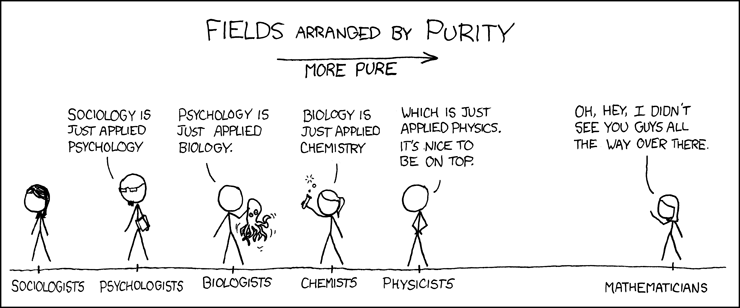
Every now and then when I tell a stranger that I study scientific psychology, I get a reaction that is perhaps best summarized by this comic from xkcd:
Essentially, the reaction is that, as a social science, psychology isn't a "real" science like biology, chemistry, or physics. I encounter this reaction often enough, even among otherwise scientifically savvy people, that I am often tempted to do silly things like shout, punch things, or at the very least launch into an ill-advised rant.
| Click for a larger image |
Essentially, the reaction is that, as a social science, psychology isn't a "real" science like biology, chemistry, or physics. I encounter this reaction often enough, even among otherwise scientifically savvy people, that I am often tempted to do silly things like shout, punch things, or at the very least launch into an ill-advised rant.
Sunday, January 9, 2011
"Evidence" for precognition hurts the perception of psychology as a science
There is a a paper in press at the most prestigious journal in my field, Journal of Personality and Social Psychology, that claims to have found evidence of ESP.
In this paper, Daryl Bem, a well-known and well-respected psychologist at Cornell University, conducted 9 time-reversed versions of classic social psychology experiments. For example, one common way of testing for associations between sets of concepts is through priming, in which an picture is flashed very quickly on a computer screen, after which the participant must categorize a second object. People are usually faster at categorizing the second object when the two objects share a relationship to each other; for example, when a picture of a rainbow (which most people agree is "good") is displayed before the participant must categorize the word "puppy" (which most people also agree is "good") as either good or bad.
Subscribe to:
Posts (Atom)